“If I fast-forward, a lot of what are just information-seeking queries will be agentic in Search. You’ll be completing tasks. You’ll have many threads running.” – Sundar Pichai
How is SEO Shifting with Agentic AI?
Search is becoming agentic. In this post, we’ll discuss what that means and how it is fundamentally changing how SEO strategy should be approached.
Agentic search is a process where an autonomous AI agent actively plans and executes multi-step web searches to find and synthesize information for a specific goal. Instead of just returning a list of links, the AI does the tedious navigating of multiple sources to compile a comprehensive, ready-to-use answer on your behalf.
The Biggest Shift in Search Since 1998
This is an exciting time to be in search marketing. As the search landscape continues to shift, recent rollouts of Claude and Gemini in Chrome will only add to the impact, changing the way both search and SEO are being conducted.
The article’s opening quote came from a recent event in which Google CEO Sundar Pichai was asked what the future of search will look like, and his response, which appears at the beginning of this post, provides a lot of SEO guidance. Essentially, he’s saying that, for many searches, users are no longer going to be doing the searching and researching. AI is going to take the question, conduct the search, analyze the information, and synthesize it in a succinct way back to the user.
These Claude- and Gemini-in-Chrome tools will streamline the way agents retrieve answers, combining insights from the open web with the chatbot’s history with the user, the user’s Google Drive, and whatever other information the user provides to power the AI. This means that whatever the AI synthesizes is going to be really good, probably in a format designed specifically for the user’s needs and what the AI knows about how they learn.
Ultimately, the implication for SEOs is that websites are going to get fewer visits, at least from human users (fewer, not zero). The theme is no longer speculative. Public statements from Pichai, Liz Reid, Google’s Head of Search, and other Google leaders confirm that search is fundamentally becoming agentic. This means the click is no longer the sole prize, and treating SEO as business-as-usual is no longer viable.
4 SEO/AIO Strategies for 2026
1. AI Performance Tracking
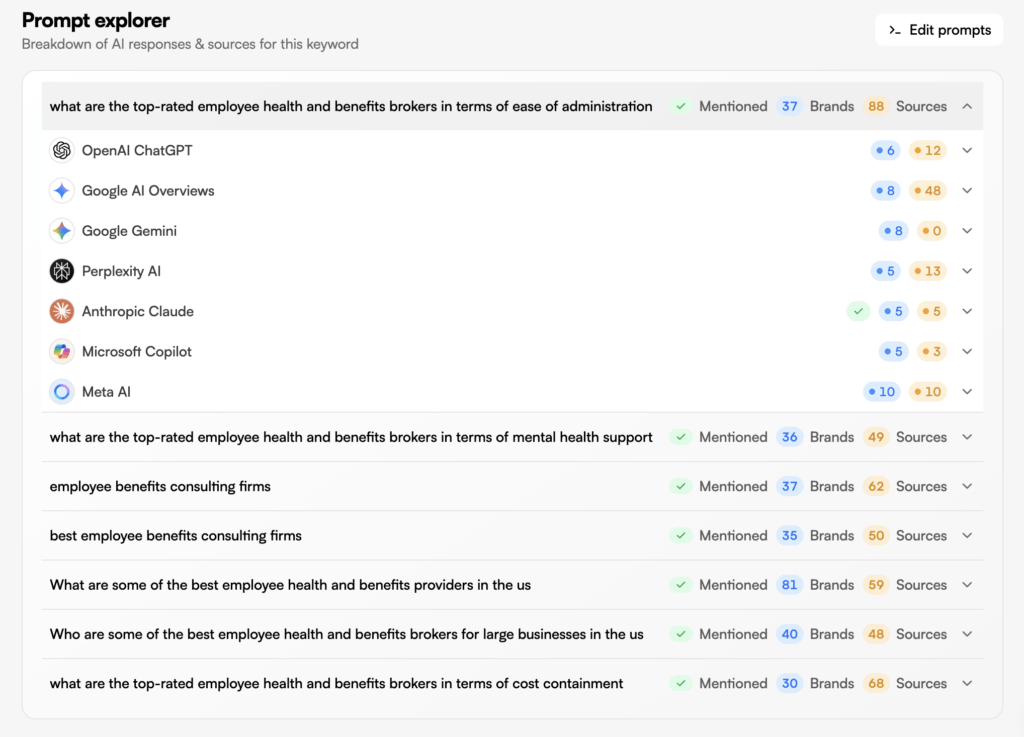
The new normal is going to be fewer clicks. Therefore, if you haven’t already, you need to start adjusting how you measure performance. There are some great tools already available—like LLMrefs, Profound, and Ahrefs Brand Radar—that help measure brand visibility within AI Overviews (AIO), brand mentions, citations in answer engines, and share-of-voice earned when an agent is performing the search.
2. Don’t Forget SEO Basics
It’s important to understand that the blue links are not going away. People and AI engines will still use Google Search, and we can’t forget the basics of SEO. Things like page titles, backlinks, and authority-building will still be relevant in 2026 and beyond. We recently released an article on the people behind Google’s search algorithms, in which we identified many of the principles on which these algorithms were built, and they have not changed much over the years. Revisiting these foundational principles is a worthwhile exercise because they still underpin how both traditional search and AI engines rank and surface content.
3. Agent Accessibility
Some AI agent documentation has recently been published on web.dev outlining best practices for building websites that these agents can easily read. This is huge for SEOs, and one of the biggest takeaways is how heavily agents rely on your website’s accessibility tree.
Accessibility has always been an adjacent discipline to SEO, but now it seems it really needs to be integrated for an effective SEO strategy.
4. Expand Your Vocabulary
Recently, Reid indicated that agents are beginning to handle real interactions across the web, spanning from initial research to final purchase. The following technical protocols make these agent-to-agent interactions possible:
UCP (Universal Commerce Protocol)
- A standard for how AI agents complete transactions on a user’s behalf. Picture a one-click checkout, except the click involves an agent negotiating prices, applying discounts, and finalizing the transaction.
- UCP is being championed by Google as a way for merchants and agents to transact through a shared standard, rather than relying on custom, site-by-site integrations. For webmasters, the takeaway is that your pricing, promotions, and checkout data increasingly need to be machine-readable so agents can act on them accurately during a purchase.
MCP (Model Context Protocol)
- An open standard that allows AI agents to securely connect to necessary tools, data, and services.
- Think of MCP as a universal adapter. So, instead of building a one-off integration for every tool, a model can use a single standardized interface to pull data, call APIs, or trigger actions across systems. For example, an agent could use MCP to check Google Search Console, Ahrefs, and Screaming Frog to identify and implement keyword opportunities or technical fixes to your webpages, all through the same protocol.
WebMCP
- An emerging layer that enables agents to interact directly with a site’s front end, allowing them to fill forms, navigate pages, and complete complex tasks.
- The key difference between MCP and WebMCP is where the agent operates. Rather than connecting to a separate backend, WebMCP lets an agent work through the website’s own interface. For webmasters, this means your existing front end effectively becomes an agent interface, so clear labels, logical navigation, and a clean page structure directly affect how reliably agents can complete tasks on your site.
We must add these terms to our vocabulary and prepare our dev teams to be up to date with implementation information. And be prepared to answer questions, because clients and internal teams will be asking about them.
Conclusion: Embracing the Agentic Web
The web is being rebuilt around agents, with search acting as the primary catalyst. The old SEO playbook remains relevant but is incomplete. Marketers who succeed will not be those who memorize new ranking factors, but those who grasp that their effective audience now includes machines acting on behalf of humans.
Experiment with Gemini in Chrome, Antigravity, Claude, or any available agent stack. The process of building with these tools fundamentally changes how one perceives—and interacts with—the web. That necessary shift in perspective is critical because the agentic web is not a future possibility. It is here.