Summary
This article explores how insights from the book How Google Works can be leveraged to build an effective and future-proof SEO strategy. By understanding the culture of the engineers who build Google’s algorithms, marketers can better align their content with what the search engine truly values.
In 2001, Eric Schmidt, the then-new CEO of Google, was attending a meeting to discuss the merits of a change to the organization’s advertising system. One shift in particular was projected to significantly increase revenue. As it was being discussed, one engineer slammed his fist on the table and said, “We can’t do that, it would be evil!” The room went silent as Eric thought, “Wow, these guys take these things seriously.”
Ultimately, Eric and the team decided not to go through with the change, and despite the loss in potential revenue, Eric would go on to lead Google as CEO for the next 10 years, overseeing an increase from $86 million to $38 billion in annual revenue over that span, a 440x growth.
The ability to challenge management’s moral compass like that may seem antithetical in many businesses. Still, at Google, it’s one of the many ways employees are empowered to ensure the business makes decisions that are truly in the best interests of users.
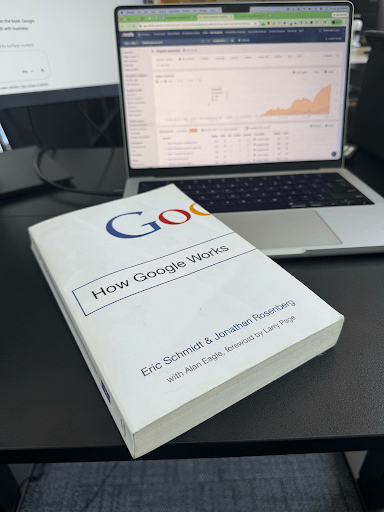
This “Don’t Be Evil” story is one of many you can find in How Google Works by Eric Schmidt and Jonathan Rosenberg, former Senior Vice President of Products at Google and current advisor to Alphabet Inc. management team and board. While the title is meant as a play on words—as the book focuses on how Google operates culturally, not how its search engine product works—this book is a goldmine for SEO’s looking to understand the people who build the algorithms, systems, and AI models that we spend our careers studying. By the end of this article, I hope it is clear how we can leverage the insights in this book to refine our approach to delivering results to our clients (all while not doing anything “evil”).
Don’t Be Evil: The End of Manipulative Tactics

As demonstrated by the engineer mentioned above, “Don’t be evil” isn’t just a PR slogan; it’s a fundamental piece of Google’s culture. So what does this mean for our SEO strategies? For one, if a tactic feels like you are tricking the user or the algorithm, Google’s engineers are actively working on a way to devalue your content. Spam, black-hat tactics, and aggressive link building are fundamentally incompatible with Google’s cultural DNA. Even if certain tactics work in the short term, it is critical to build a strategy focused on earning links and traffic through undeniable value, rather than finding loopholes in the system.
Here is an example of a Rebellion Group client that implemented this strategy. Over the past several years, I’ve had the pleasure of working with a talented team of entrepreneurs who built an outstanding software development agency. This group really cares about their work, and their passion for their product radiates through the content they build. During our engagement, each blog post on their site was either written or edited by their internal team. They had free rein to write about whatever interested them and whatever they thought would be helpful to their audience (similar to how Google’s engineers often have free rein to work on passion projects).
Almost every month over the 8 years we worked on this blog, we would see an increase in backlinks, referring domains, and keyword performance, all from just writing about what the team was passionate about. No backlink outreach, no keyword stuffing, no link schemes, no semantic chunking. Some light internal linking, adding clear titles and headings, and some minimal restructuring to make the content flow were all that was done to optimize the posts.
This is one of many examples we have seen at Rebellion Group where focusing on making content as helpful to users as possible has delivered positive results.
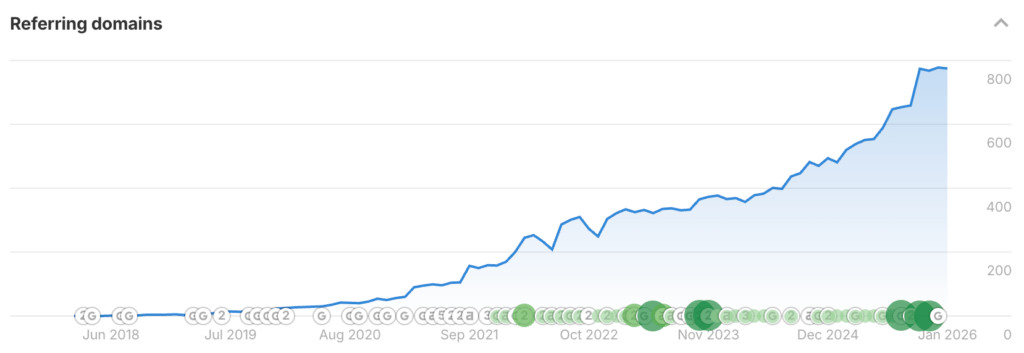
The growth in referring domains for this client should illustrate that if you produce content that people find helpful, they will cite it!
Some of you who have already heard the “just make good content” argument may read this section and think to yourself, “ok, sure, but that still leaves ‘good’ up to interpretation.” This is a great point, and while there is value in this general approach, it leaves us with many unanswered questions regarding what good content is. Luckily, How Google Works provides us with insight into how we can better understand the parameters of quality content.
The Smart Creative and the Standard for Content Quality
If you want to understand what Google considers quality, you first have to understand the people who define the term.
In How Google Works, Schmidt and Rosenberg introduce the archetype of the Google employee: the Smart Creative. These people are intensely curious and constantly asking “why?” They are comfortable with ambiguity and thrive in chaos. They are fiercely analytical, meaning they base their arguments on data rather than rank or title. As the example above shows, they will happily argue with a CEO if the data supports their case. Above all else, they are fundamentally allergic to mediocrity and the status quo.
The book explicitly breaks down the anatomy of a Smart Creative into three overlapping pillars:
- Technical Depth
They aren’t just big-picture thinkers; they have deep, specialized, hands-on expertise. They understand the tools of their trade inside and out and aren’t afraid to get their hands dirty doing the actual work.
- Business Acumen
They understand that technical brilliance is useless if it doesn’t solve a real-world problem or create value. They see the commercial and operational context of their work.
- Creative Flair
They don’t just follow the standard playbook. They synthesize information from disparate sources to find unorthodox, highly innovative solutions.
SEO Strategy Implications
Google’s employee culture has a direct effect on your organic traffic. You have to remember who is writing the code and training the machine learning models that dictate search rankings. Google’s engineers are Smart Creatives. When they design algorithms, core updates, and Quality Rater Guidelines, they are essentially building automated systems designed to surface content that they would find valuable.
An algorithm built by Smart Creatives isn’t looking for a 1,500-word article that simply regurgitates the top three results. It is looking for depth, originality, and authority.
To optimize for an algorithm built by Smart Creatives, your content strategy needs to reflect their standards. Here is how to put that into practice:
Experience, Expertise, Authoritativeness, Trustworthiness (E-E-A-T)
Smart creatives don’t blindly trust unsourced claims, and neither does Google’s algorithm. Your content needs clear authorship, demonstrable firsthand experience, and authoritative citations. You have to prove why you are qualified to talk about the subject.
“Information Gain” Score
Patents filed by Google explicitly mention “information gain scores,” which measure how much new information a page brings to a topic compared to what is already ranking. Bring original research, unique data, or a contrarian perspective to the table.
Fluff
High-performing engineers value efficiency above almost everything else. Treat your users the same way. Cut the meandering, keyword-stuffed introductions and get straight to the value.
Unedited Automation
If your content strategy relies on churning out cheap, low-effort articles, you are fighting a losing battle. You are feeding mundane, average content to an algorithm explicitly built to filter out the mundane and average.
Defaulting to the User
“Focus on the user and all else will follow.”
In How Google Works, the authors dedicate a significant amount of time to this concept. They explain that in the early days of Google, there was intense pressure to monetize the search engine immediately. Instead, leadership held firm on a core belief: build a superior product that delivers the best user experience, and trust that the revenue will eventually figure itself out. In short, they prioritized long-term user satisfaction over short-term monetization.
Google’s algorithms are a manifestation of its user-first philosophy. The machine learning systems driving the core algorithms are explicitly trained to act as a proxy for a highly impatient, goal-oriented human user. Google wants to serve the best possible answer, as quickly as possible, with the least amount of friction.
SEO Strategy Implications
Optimizing Readability for Users (& Large Language Models)
Your website’s user experience should focus on delivering information with the least amount of friction. To achieve this:
- Break down large blocks of text using clear headings, bolded passages, and bullet points.
- Consider supplementing text with infographics or video content for different learning styles.
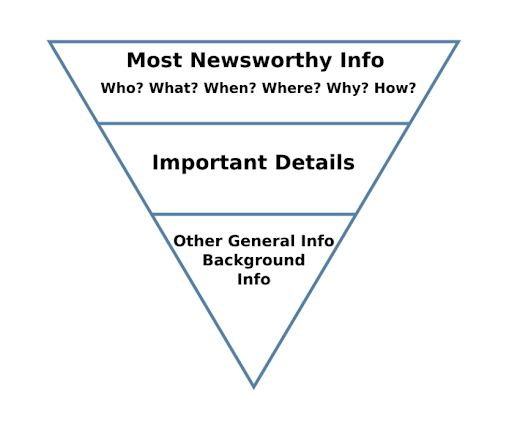
- Structure your articles using the inverted pyramid style of journalism, putting the most critical information at the very top.
This focus on concise answers and solid structure not only benefits human readers but also helps AI models and crawlers, which may be restricted by a “Grounding Budget” when synthesizing information.
Writing for Clarity & Trust
A user-first approach means that your content is credible and transparent. To write for clarity and trust:
- Make your text more fluent and readable.
- Include summaries on longer-form content.
- Avoid technical jargon, or at least define it.
- Cite trustworthy sources in your content when you use them, especially when leveraging quotes and statistics.
- Leverage real experts.
- Can give them reviewed by or editor credits if they did not write the post.
- Consider producing primary research to inform your content.
Informing AND Entertaining
Avoid straightforward informational content that can be easily answered by an LLM (e.g., “what is SEO”). Instead, your content strategy should focus on specificity and audience-fit. For example, consider trying to answer questions like “Which option is the best for [a specific persona]?” with expert insight from people with direct experience with the product or service.
Finally, ensure your content is conversational. You have a personal style and a sense of humor… use them! Develop a content creator persona that offers unique opinion pieces that get users coming back for more.
Conclusion
Of course, there is more to SEO and AIO than trying to understand the people behind the algorithms, but it’s a start, and one that is often overlooked. It may be natural to think of Google as only algorithms, but if we can align ourselves with the values and psychology that Google’s engineers encode into their algorithms, our clients can feel confident that we are future-proofing our SEO strategies, an increasingly prominent concern among businesses.
Glossary:
E-E-A-T: E-E-A-T is an acronym used in SEO that stands for Experience, Expertise, Authoritativeness, and Trustworthiness. It is a framework found in Google’s Search Quality Rater Guidelines, which human “Quality Raters” use to evaluate the quality and credibility of search results. While E-E-A-T is not a direct ranking factor (meaning there isn’t a “score” for it in Google’s algorithm), Google’s automated systems aim to prioritize content that aligns with these standards. It is particularly crucial for YMYL (Your Money or Your Life) topics—such as health, finance, and safety—where poor information could cause real-world harm.
Grounding budget: A “grounding budget” in SEO refers to a technical limitation in AI search engines (like Google’s AI Overviews) where only a limited amount of content—approximately 2,000 words total per query—is extracted from search results to generate an answer.